
The Art of Invisible Architecture
The Physics of Ambiance: Why Precision Beam Engineering is the Secret to Resort-Level Landscapes
The Art of Invisible Architecture
In the world of high-end design, the most common landscape pitfall is the "floodlight fallacy"—the urge to saturate an exterior with generic, high-intensity light that flattens textures and creates aggressive glare. To the untrained eye, more light equals better visibility; to the architectural lighting consultant, it is a missed opportunity for drama. The "resort" aesthetic that defines luxury properties isn't about volume; it is about "invisible architecture." This philosophy treats light as the ultimate spatial punctuation, using it to define boundaries and reveal the skeletal beauty of a garden at night. The in-lite FLUX and BIG FLUX series serve as a masterclass in this approach, offering a sophisticated toolkit of integrated LED technology designed for curation, not just illumination.
The Precision of Beam Angles: Intensity Over Area
A sophisticated design requires understanding that a wider beam is often the enemy of impact. As a consultant, I look for how a fixture manages its output. Consider the lens engineering of the BIG FLUX series: both the standard and the NARROW models operate on a modest 3.0W, yet their visual impact is worlds apart.
While the standard BIG FLUX provides a 26° spread at 852.00 Cd, the BIG FLUX NARROW uses precision optics to compress that energy into a surgical 13° beam. This isn't just a tighter circle; it is a massive amplification of power.
Luminous intensity: 1,848.60 Cd | Light beam: 13°
By narrowing the focus, the NARROW model achieves a staggering intensity that allows light to remain cohesive across vast distances. According to the series’ "Distance" chart, the 13° beam maintains its integrity even at 11 meters (36 feet), making it the ideal choice for highlighting tall, slender evergreens—as seen in contemporary estate photography where light reaches the highest canopy without dissipating into the night sky. To ensure these fixtures disappear into the hardscape during the day, they are available with Ring 68 finishes in Stainless Steel, Pearl Grey, or Black, allowing them to blend seamlessly into modern masonry or dark shadows.
 BIG FLUX NARROW
The Asymmetric Advantage for Wall Washing
For vertical surfaces, traditional circular beams often create "scalloping"—those amateurish semi-circles of light that distract from a building's lines. The BIG FLUX ASYMMETRIC solves this with a specialized 18° x 65° rectangular beam.
This asymmetry is a deliberate engineering choice to provide "wall washing" with surgical precision. In high-end installations, we see this fixture utilized to send light climbing through narrow rectangular cutouts in white architectural walls. By directing the light precisely along the vertical plane, the ASYMMETRIC model avoids wasting light on the ground or sky, creating clean, sharp geometric lines that emphasize the home’s structure rather than burying it in light spill.
 BIG FLUX ASYMMETRIC
The Truth About Color Fidelity: CRI 90+
Brightness is quantitative, but quality is qualitative. The "quality" of an outdoor space at night is dictated by the Color Rendering Index (CRI). The FLUX series sets a professional benchmark with CRI values of 92 for the standard FLUX and 93 for the BIG FLUX series.
In a garden environment, high CRI is non-negotiable. Lower-quality LEDs often render lush foliage as a muddy, desaturated grey. With a specialized color temperature of 3100 K for the BIG FLUX (and 3000 K for the standard FLUX), these fixtures ensure that stone looks natural and plants retain their vibrant greens. This fidelity ensures that the landscape appears as a curated extension of the home’s interior, rather than an artificial, "washed-out" environment.
Smart Tones and Atmospheric Zoning
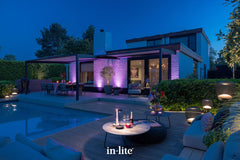
Beyond illumination, light serves as a tool for "zoning"—changing the function of a space through color. The SMART FLUX TONE technology allows for a sophisticated layering of the exterior canvas. Atmospheric photography, such as the voque.jpg study, illustrates this beautifully: a patio is transformed into a lounge through deep purple hues highlighting the brickwork, which contrasts sharply with the warm, inviting amber glow seen through the home’s glass doors.
This creates a dual-layer experience. By using color to define different zones—perhaps a cool blue for the pool perimeter and a warm amber for the dining area—the designer prevents a "one-size-fits-all" scene. It allows the architecture to remain static while the atmosphere evolves to suit the occasion, from a high-energy social gathering to an intimate midnight retreat.
 FLUX SMART TONE & VOQUE Transforming a patio with precision illumination and decadent lighting.
Built for the Elements: The IP67 Standard
The most brilliant lighting design is worthless if it cannot withstand the environment. In the "boring but essential" category of specifications, the IP67 rating is the most critical. This standard ensures the hardware is completely sealed against dust and can withstand temporary immersion in water—a necessity for fixtures integrated into soil or pathways.
With a rated lifetime of 25,000 hours and a 5-year warranty, these fixtures are built for longevity. This reliability ensures that the meticulously planned beam angles and color temperatures remain consistent for years, protecting the homeowner's investment against the degradation typically caused by rain, soil acidity, and temperature fluctuations.
A New Perspective on the Night
The transition from a simple yard to a resort-level landscape begins the moment you stop "lighting up the dark" and start sculpting with precision. Engineering choices—like choosing between a 13° narrow beam for a specimen tree or a 65° asymmetric beam for a stone wall—are what separate amateur attempts from professional masterpieces.
When you look at your outdoor space tonight, ask yourself: Are you merely lighting your property, or are you actually designing it with light?
The final takeaway is clear: successful lighting design is defined by the precision of the beam, not the volume of the light. For decadent lighting solutions, contact us, we'd be delighted to assist.
- The total wattage or VA of the fixtures you plan to connect?
- The rough distances between the transformer and your furthest light points?
- If you need a checklist of compatible cables, connectors, or fixtures?